At least one American dead in Algerian hostage crisis

Updated at 6:41 p.m. ET

An American in the Algerian hostage standoff in the Algerian desert has been killed, CBS News has learned.

Fredrick Buttaccio from Katy, Texas near Houston, was an employee of the oil company BP. It is unknown how he died, but U.S. government sources tell CBS News his body has been recovered and his family has been notified.

Meanwhile, a U.S. military plane has landed in Amenas, Algeria to pick up nine passengers - one American and eight foreign nationals - to be transported to Landstuhl, Germany, a military source told CBS News.

The flight, which contains an air medical evacuation team, was expected to have departed Algeria by Thursday afternoon.

It's not clear exactly how many total casualties have resulted from the fighting, but Algeria's state news agency reported that 12 foreign and Algerian workers had died since the start of the operation, citing an unidentified security source. That information could not be independently confirmed.

As CBS News correspondent Mark Phillips reported, the freed hostages told of how they fled in the confusion as the Algerian army attacked. Many were injured, some badly. One person said: "It happened so fast."

But it hasn't ended quickly, reported Phillips. The Algerians say they've freed nearly a hundred foreigners. And as they were being bused away, many thanked their rescuers. "They kept us all nice and safe and fought off the bad guys," said another person.

Also, more detail of the ordeal has emerged with the freed hostages. Some say they had explosives hung around their necks as they were placed in a convoy of vehicles by their captors. When the cars began to move, the Algerian Army units surrounding the site feared the captives were being taken out of the compound -- and opened fire.

The al Qaeda-linked Masked Battalio, led from afar by Moktar Belmoktar, may still be holding some of the roughly 30 foreigners still unaccounted for.

U.S. Secretary of State Hillary Clinton did not get into specifics on the crisis Friday afternoon, but described it as an "extremely difficult and dangerous situation" and called on the Algerian government to "preserve innocent life" in their efforts to fully resolve the crisis. Clinton spoke after the State Department said that Americans were still being held hostage.

The desert siege erupted Wednesday when the militants attempted to hijack two buses at the plant, were repulsed, and then seized the sprawling refinery, which is 800 miles south of Algiers. They had claimed the attack came in retaliation for France's recent military intervention against Islamist rebels in neighboring Mali, but security experts have said it must have taken weeks of planning to hit the remote site.

Since then, Algeria's government has kept a tight grip on information about the siege.

The militants had seized hundreds of workers from 10 nations at Algeria's remote Ain Amenas natural gas plant. The overwhelming majority were Algerian and were freed almost immediately.

Algerian forces retaliated Thursday by storming the plant in an attempted rescue operation that left leaders around the world expressing strong concerns about the hostages' safety.

Militants claimed 35 hostages died on Thursday when Algerian military helicopters opened fire as the Islamists transported the hostages around the gas plant. While Algerian officials acknowledged some hostage deaths, the number could not be independently confirmed.

On Friday, trapped in the main refinery area, the militants offered to trade two American hostages for two prominent terror figures jailed in the United States. Those the militants sought included Omar Abdel Rahman, the blind sheikh who was convicted of plotting to blow up New York City landmarks and considered the spiritual leader of the 1993 World Trade Center bombing, and Aafia Siddiqui, a Pakistani scientist convicted of shooting at two U.S. soldiers in Afghanistan.

But U.S. Defense Secretary Leon Panetta said there would be "no place to hide" for anyone who looks to attack the United States.

"Terrorists should be on notice that they will find no sanctuary, no refuge, not in Algeria, not in North Africa, not anywhere," Panetta said Friday.

Workers kidnapped by the militants came from around the world -- Americans, Britons, French, Norwegians, Romanians, Malaysians, Japanese, Algerians.


Amenas gas facility, algeria

A high-resolution satellite image of the Amenas gas facility taken on Dec 7, 2012.


/

GeoEye Satellite Image

World leaders have expressed strong concerns in the past few days about how Algeria was handing the situation and its apparent reluctance to communicate.

Terrorized hostages from Ireland and Norway trickled out of the plant. BP, which jointly operates the plant, said it had begun to evacuate employees from Algeria.

A U.S. military C-130 transport plane flew a number of people including former Ain Amenas hostages from the Algerian capital of Algiers to a U.S. facility in Europe, a U.S. official said. He declined to be specific about the destination, their nationalities or the extent of the wounds that he said some had.

A flood of foreign energy workers were being evacuated from the North African nation amid security concerns.

BP evacuated one U.S. citizen along with other foreign energy workers from Algeria to Mallorca and then London. The oil giant said three flights left Algeria on Thursday, carrying 11 BP employees and several hundred energy workers from other companies.

A fourth plane was taking more people out of the country on Friday, BP said.

Read More..

Armstrong May Have Lied to Oprah: Investigators


Lance Armstrong may have lied to Oprah Winfrey during his so-called confession Thursday night about his doping during the Tour de France bicycle race, investigators told ABC News today.


Armstrong, 41, admitted for the first time that his decade-long dominance of cycling and seven wins in the Tour de France were owed, in part, to performance-enhancing drugs and oxygen-boosting blood transfusions. He told Winfrey that he was taking the opportunity to confess to everything he had done wrong, including angrily denying reports for years claiming that he had doped.


Investigators familiar with Armstrong's case, however, said today that Armstrong didn't completely come clean. They say he blatantly lied about when he stopped doping, saying the last time he used the drugs and transfusions was the 2005 race.


"That's the only thing in this whole report that upset me," Armstrong said during the interview. "The accusation and alleged proof that they said I doped [in 2009] is not true. The last time I crossed the line, that line was 2005."


"You did not do a blood transfusion in 2009?" Winfrey asked.


"No, 2009 and 2010 absolutely not," Armstrong said.


Investigators familiar with the case disagree. They said today that Armstrong's blood values at the 2009 race showed clear blood manipulation consistent with two transfusions. Armstrong's red blood cell count suddenly went up at these points, even though the number of baby red blood cells did not.


Investigators said this was proof that he received a transfusion of mature red blood cells.


If Armstrong lied about the 2009 race, it could be to protect himself criminally, investigators said.


READ MORE: 10 Scandalous Public Confessions


PHOTOS: Olympic Doping Scandals: Past and Present


PHOTOS: Tour de France 2012


Federal authorities looking to prosecute criminal cases will look back at the "last overt act" in which the crime was committed, they explained. If Armstrong doped in 2005 but not 2009, the statute of limitations may have expired on potential criminal activity.


Lance Armstrong-Winfrey Interview: How Honest Was He? Watch Video


The sources noted that there is no evidence right now that a criminal investigation will be reopened. Armstrong is facing at least three civil suits.


The second half of Armstrong's interview is set to air tonight.


Shock and disenchantment were among the reactions from people most familiar with the famed cyclist's history after his on-air confession Thursday night.


"I could not believe that Lance apologized," Betsy Andreu, the wife of Armstrong's former teammate and close friend Frankie Andreu, said today on ABC's "Good Morning America".


"Lance doesn't say, 'I'm sorry.' Lance isn't used to telling the truth and so I think in the days to come, in the months to come, I'm hoping that we'll see the contrition. Actions speak louder than words so if the words aren't empty ...," Andreu said.


ABC News consultant and USA Today columnist Christine Brennan called Armstrong's admitting that he used performance-enhancing drugs "a major miscalculation."


"This is like Bernie Madoff coming back after three months or Richard Nixon coming back after three months. No one wants to hear from those people so soon," Brennan told George Stephanopoulos on "Good Morning America."


"It was a lose-lose going in. I think he did more harm than good to his reputation, and he just looked cold-blooded, and cutthroat, and ruthless," Brennan said.


Minutes after Armstrong's confession aired on Oprah Winfrey's OWN network, the Livestrong Foundation -- the Austin-Texas-based cancer charity that he founded -- released a statement expressing disappointment in their former leader.


"We at the LIVESTRONG Foundation are disappointed by the news that Lance Armstrong misled people during and after his cycling career, including us," the statement read. "Earlier this week, Lance apologized to our staff and we accepted his apology in order to move on and chart a strong, independent course.


"Our success has never been based on one person -- it's based on the patients and survivors we serve every day, who approach a cancer diagnosis with hope, courage and perseverance."


READ MORE: Did Doping Cause Armstrong's Cancer?


Travis Tygart, head of the U.S. Anti-Doping Agency, said in a statement, "Tonight, Lance Armstrong finally acknowledged that his cycling career was built on a powerful combination of doping and deceit. His admission that he doped throughout his career is a small step in the right direction. But if he is sincere in his desire to correct his past mistakes, he will testify under oath about the full extent of his doping activities."


The agency issued an October report in which 11 former Armstrong teammates described the system under which they and Armstrong received drugs with, they say, the knowledge of their coaches and help of team physicians. As a result of the organization's findings, Armstrong was stripped of his seven Tour de France titles. Soon, longtime sponsors including Nike began to abandon him, too.


John Fahey, president of the World Anti-Doping Agency said, "He was wrong, he cheated and there was no excuse for what he did. If he was looking for redemption, he didn't succeed in getting that."


Such a reaction\ to the highly anticipated interview was only the tip of the iceberg as pundits, those close to Armstrong and even everyday people took to Twitter and other social media outlets to share their thoughts on what Armstrong said was "one big lie that I repeated a lot of times."


Cyclist and former Armstrong teammate Jonathan Vaughters tweeted, "A good first step. I need to sleep."


Read More..

Algeria ends desert siege, but dozens killed


ALGIERS (Reuters) - Algerian forces stormed a desert gas complex to free hundreds of hostages but 30, including several Westerners, were killed in the assault along with at least 11 of their Islamist captors, an Algerian security source told Reuters.


Western leaders whose compatriots were being held did little to disguise their irritation at being kept in the dark by Algeria before the raid - and over its bloody outcome. French, British and Japanese staff were among the dead, the source said.


An Irish engineer who survived said he saw four jeeps full of hostages blown up by Algerian troops whose commanders said they moved in about 30 hours after the siege began because the gunmen had demanded to be allowed to take their captives abroad.


And while a crisis has ended that posed a serious dilemma for Paris and its allies as French troops attacked the hostage-takers' al Qaeda allies in neighboring Mali, it left question marks over the ability of OPEC-member Algeria to protect vital energy resources and strained its relations with Western powers.


Two Japanese, two Britons and a French national were among at least seven foreigners killed, the source told Reuters. Eight dead hostages were Algerian. The nationalities of the rest, as well as of perhaps dozens more who escaped, were unclear. Some 600 local Algerian workers, less well guarded, survived.


Fourteen Japanese were among those still unaccounted for by the early hours of Friday, their Japanese employer said.


Americans, Norwegians, Romanians and an Austrian have also been mentioned by their governments as having been captured by the militants who called themselves the "Battalion of Blood" and had demanded France end its week-old offensive in Mali.


Underlining the view of African and Western leaders that they face a multinational Islamist insurgency across the Sahara - a conflict that prompted France to send hundreds of troops to Mali last week - the official source said only two of the 11 dead militants were Algerian, including the squad's leader.


The bodies of three Egyptians, two Tunisians, two Libyans, a Malian and a Frenchman were found, the security source said.


The group had claimed to have dozens of guerrillas on site and it was unclear whether any militants had managed to escape.


The overall commander, Algerian officials said, was Mokhtar Belmokhtar, a veteran of Afghanistan in the 1980s and Algeria's bloody civil war of the 1990s. He appears not to have been present and has now risen in stature among a host of Saharan Islamists, flush with arms and fighters from chaotic Libya, whom Western powers fear could spread violence far beyond the desert.


"NO TO BLACKMAIL"


Algeria's government spokesman made clear the leadership in Algiers remains implacably at odds with Islamist guerrillas who remain at large in the south years after the civil war in which some 200,000 people died. Communication Minister Mohamed Said repeated their refusal ever to negotiate with hostage-takers.


"We say that in the face of terrorism, yesterday as today as tomorrow, there will be no negotiation, no blackmail, no respite in the struggle against terrorism," he told APS news agency.


British Prime Minister David Cameron, who warned people to prepare for bad news and who canceled a major policy speech on Friday to deal with the situation, said through a spokesman that he would have liked Algeria to have consulted before the raid.


A Briton and an Algerian had also been killed on Wednesday.


The prime minister of Norway, whose state energy company Statoil runs the Tigantourine gas field with Britain's BP and Algeria's national oil company, said he too was not informed.


U.S. officials had no clear information on the fate of Americans, though a U.S. military drone had flown over the area. Washington, like its European allies, has endorsed France's move to protect the Malian capital by mounting air strikes last week and now sending 1,400 ground troops to attack Islamist rebels.


A U.S. official said on Thursday it would provide transport aircraft to help France with a mission whose vital importance, President Francois Hollande said, was demonstrated by the attack in Algeria. Some fear, however, that going on the offensive in the remote region could provoke more bloodshed closer to home.


The apparent ease with which the fighters swooped in from the dunes to take control of an important energy facility, which produces some 10 percent of the natural gas on which Algeria depends for its export income, has raised questions, over the value of security measures that are outwardly draconian.


Foreign firms were pulling non-essential staff out of the country, which has recovered stability only in recent years and whose ruling establishment, heirs to fighters who ended French rule 50 years ago, has resisted demands for reform and political freedoms of the kind that swept North Africa in the Arab Spring.


"The embarrassment for the government is great," said Azzedine Layachi, an Algerian political scientist at New York's St John's University. "The heart of Algeria's economy is in the south. where the oil and gas fields are. For this group to have attacked there, in spite of tremendous security, is remarkable."


"KILL INFIDELS"


A local man who had escaped from the facility told Reuters the militants appeared to have inside knowledge of the layout of the complex, supporting the view of security experts that their raid was long-planned, even if the Mali war provided a motive.


"The terrorists told us at the very start that they would not hurt Muslims but were only interested in the Christians and infidels," Abdelkader, 53, said by telephone from his home in the nearby town of In Amenas. "'We will kill them,' they said."


Algiers, whose leaders have long had frosty relations with the former colonial power France and other Western countries, may have some explaining to do over its tactics in putting an end to a hostage crisis whose scale was comparable to few in recent decades bar those involving Chechen militants in Russia.


Government spokesman Said sounded unapologetic, however: "When the terrorist group insisted on leaving the facility, taking the foreign hostages with them to neighboring states, the order was issued to special units to attack the position where the terrorists were entrenched," he told state news agency APS, which said some 600 local workers were freed.


The militants said earlier they had 41 foreign hostages.


"ARMY BLASTED HOSTAGES"


Stephen McFaul, an electrical engineer, told his family in Northern Ireland after the operation that he narrowly escaped death, first when bound and gagged by the gunmen who fastened explosives around the hostages' necks and then on Thursday when he was in a convoy of five vehicles driving across the complex.


"(The gunmen) were moving five jeeploads of hostages from one part of the compound," his brother Brian McFaul said. "At that stage, they were intercepted by the Algerian army.


"The army bombed four out of five of the trucks and four of them were destroyed ... He presumed everyone else in the other trucks was killed ... The truck my brother was in crashed and at that stage Stephen was able to make a break for his freedom."


McFaul said it was unclear whether the vehicles had been struck by missiles fired from helicopters or by ground forces.


The attack in Algeria did not stop France from pressing on with its campaign in Mali. It said on Thursday it now had 1,400 troops on the ground there, and combat was under way against the rebels that it first began targeting from the air last week.


"What is happening in Algeria justifies all the more the decision I made in the name of France to intervene in Mali in line with the U.N. charter," Hollande said on Thursday.


The French action last week came as a surprise but received widespread public international support. Neighboring African countries planning to provide ground troops for a U.N. force by September have said they will move faster to deploy them.


(Additional reporting by Ali Abdelatti in Cairo, Eamonn Mallie in Belfast, Gwladys Fouche in Oslo, Mohammed Abbas in London and Padraic Halpin and Conor Humprhies in Dublin; Writing by Alastair Macdonald; Editing by Peter Millership)


Read More..

Campaigning in Punggol East intensifies as candidates make early start


SINGAPORE: Campaigning in the Punggol East by-election intensifies, with candidates making an early start to catch voters from all walks of life.

On Friday morning, Dr Koh Poh Koon of the People's Action Party (PAP) and Mr Kenneth Jeyaretnam of the Reform Party (RP) were at Rumbia LRT Station, near Rivervale Mall, to catch the morning crowd.

They were distributing flyers.

Dr Koh told reporters that his secret during the gruelling campaign is to sleep enough and drink lots of water.

The PAP will hold its first rally in the constituency on Friday night.

-CNA/ac


Read More..

Europe's space agency kicks off asteroid collision mission


Art rendering of the Asteroid Impact and Deflection Mission concept.


(Credit:
European Space Agency )


Doomsday isn't far from many people's imaginations, whether it's the end of the Mayan calendar, the rapture, or a massive asteroid smashing into the Earth. Now, one of these far-flung scenarios may become even less likely.

The European Space Agency announced this week that it's in the beginning phases of an "Asteroid Impact and Deflection Mission" with its U.S. partner Johns Hopkins Applied Physics Laboratory. The eventual goal of the mission is to verify whether scientists can collide with an asteroid that's hurtling through space -- so as to avoid any possible impact with Earth.

"Concepts are being sought for both ground- and space-based investigations, seeking improved understanding of the physics of very high-speed collisions involving both man-made and natural objects in space," the ESA wrote in a statement.

The eventual plan is for scientists to shuttle off two small spacecraft in the year 2020 in pursuit of a 2,625-foot binary asteroid named 65803 Didymos, according to The Verge. Didymos is reportedly traveling side-by-side with a smaller 500-foot twin asteroid.

Using the smaller asteroid as target practice, scientists will point one of the spacecraft at the flying rock and collide with it. The other spacecraft will be in charge of surveying the damage and seeing if the impact changed the course of the twin asteroids.

"Both missions become better when put together -- getting much more out of the overall investment," the ESA's Asteroid Impact and Deflection Mission study manager said in a statement about the benefits of using two spacecraft. "And the vast amounts of data coming from the joint mission should help to validate various theories, such as our impact modelling."

The possibility of an asteroid crashing into Earth isn't actually that far-out of an idea. In 2004, NASA scientists discovered a massive 22 million ton asteroid that was well on course to hit the planet in 2029. However, after copious research, scientists concluded Earth was safe from an impact scenario. NASA also recently ruled out another possible 2036 asteroid collision.

Read More..

Manti Te'o kept girlfriend myth alive after revelation

SOUTH BEND, Ind. Not once but twice after he supposedly discovered his online girlfriend of three years never even existed, Notre Dame All-American linebacker Manti Te'o perpetuated the heartbreaking story about her death.


13 Photos


Manti Te'o


An Associated Press review of news coverage found that the Heisman Trophy runner-up talked about his doomed love in a Web interview on Dec. 8 and again in a newspaper interview published Dec. 11. He and the university said Wednesday that he learned on Dec. 6 that it was all a hoax, that not only wasn't she dead, she wasn't real.

On Thursday, a day after Te'o's inspiring, playing-through-heartache story was exposed as a bizarre lie, Te'o and Notre Dame faced questions from sports writers and fans about whether he really was duped, as he claimed, or whether he and the university were complicit in the hoax and misled the public, perhaps to improve his chances of winning the Heisman.

Yahoo sports columnist Dan Wetzel said the case has "left everyone wondering whether this was really the case of a naJive football player done wrong by friends or a fabrication that has yet to play to its conclusion."

Gregg Doyel, national columnist for CBSSports.com, was more direct.

"Nothing about this story has been comprehensible, or logical, and that extends to what happens next," he wrote. "I cannot comprehend Manti Te'o saying anything that could make me believe he was a victim."

On Wednesday, Te'o and Notre Dame athletic director Jack Swarbrick said the player was drawn into a virtual romance with a woman who used the phony name Lennay Kekua, and was fooled into believing she died of leukemia in September. They said his only contact with the woman was via the Internet and telephone.

Te'o also lost his grandmother — for real — the same day his girlfriend supposedly died, and his role in leading Notre Dame to its best season in decades endeared him to fans and put him at the center of college football's biggest feel-good story of the year.

Relying on information provided by Te'o's family members, the South Bend Tribune reported in October that Te'o and Kekua first met, in person, in 2009, and that the two had also gotten together in Hawaii, where Te'o grew up.

Te'o never mentioned a face-to-face meeting with Kekua in public comments reviewed by the AP. And an AP review of media reports about Te'o since Sept. 13 turned up no instance in which he directly confirmed or denied those stories — until Wednesday.

Among the outstanding questions Thursday: Why didn't Te'o ever clarify the nature of his relationship as the story took on a life of its own?

Te'o's agent, Tom Condon, said the athlete had no plans to make any public statements Thursday in Bradenton, Fla., where he has been training with other NFL hopefuls at the IMG Academy.

Notre Dame said Te'o found out that Kekau was not a real person through a phone call he received at an awards ceremony in Orlando, Fla., on Dec. 6. He told Notre Dame coaches about the situation on Dec. 26.


Play Video


Manti Te'o's girlfriend hoax: How did it happen?


The AP's media review turned up two instances during that gap when the football star mentioned Kekua in public.

Te'o was in New York for the Heisman presentation on Dec. 8 and, during an interview before the ceremony that ran on the WSBT.com, the website for a South Bend TV station, Te'o said: "I mean, I don't like cancer at all. I lost both my grandparents and my girlfriend to cancer. So I've really tried to go to children's hospitals and see, you know, children."

In a story that ran in the Daily Press of Newport News, Va., on Dec. 11, Te'o recounted why he played a few days after he found out Kekau died in September, and the day she was supposedly buried.

"She made me promise, when it happened, that I would stay and play," he said.

On Wednesday, Swarbrick said Notre Dame did not go public with its findings sooner because it expected the Te'o family to come forward first. But Deadspin.com broke the story Wednesday.

Reporters were turned away Thursday at the main gate of IMG's sprawling, secure complex. Te'o remained on the grounds, said a person familiar with situation who spoke on condition of anonymity because neither Te'o nor IMG authorized the release of the information.

"This whole thing is so nutsy that I believe it only could have happened at Notre Dame, where mythology trumps common sense on a daily basis. ... Given the choice between reality and fiction, Notre Dame always will choose fiction," sports writer Rick Telander said in the Chicago Sun-Times.

"Which brings me to what I believe is the real reason Te'o and apparently his father, at least went along with this scheme: the Heisman Trophy.

Chicago Tribune columnist John Kass blasted both Te'o and Notre Dame.

"When your girlfriend dying of leukemia after suffering a car crash tells you she loves you, even if it might help you win the Heisman Trophy, you check it out," he said.

He said the university's failure to call a news conference and go public sooner means "Notre Dame is complicit in the lie."

"The school fell in love with the Te'o girlfriend myth," he wrote.

Read More..

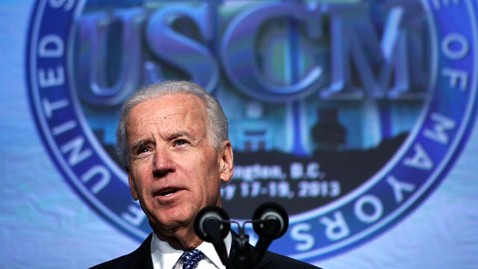
Biden Confirms Support for Second Amendment


Jan 17, 2013 6:41pm


gty joe biden mayors nt 130117 wblog Biden Confirms Support for Second Amendment, Says He Owns Two Shotguns

Alex Wong/Getty Images


One day after President Obama unveiled the administration’s plan to curb gun violence, Vice President Joe Biden today defended their intentions, answering critics who have spoken out against the plan for potentially infringing on the Second Amendment rights of Americans.


“The president and I support the Second Amendment,”  Biden said definitively.


Biden, who’s led the task force on gun violence since the December shooting at Sandy Hook Elementary School, noted that he owns guns.


“I have two shotguns, a 20-gauge and a 12-gauge shotgun,” he said. Later in the speech he said his son Beau was a better shot than he is but that is because Beau is in the Army.


Biden spoke today before the annual U.S. Conference of Mayors’ meeting in Washington, D.C. Not everyone in the audience, Biden noted today, agrees with recommendations the White House put forward yesterday. But he defended the administration’s move to push this issue, at one point addressing the roomful of mayors as if he were speaking to them individually, saying that “murder rates in both of our towns are …  well beyond … what’s remotely tolerable for a civilized circumstance.”


“We’re going to take this fight to the halls of Congress,” he said. “We’re going to take it beyond that. We’re going to take it to the American people. We’re going to go around the country making our case, and we’re going to let the voices, the voice, of the American people be heard. ”


Biden again noted that there will not be consensus across the nation, given cultural differences among the states. In many states, he added, hunting is  “big deal.”


But, he quipped, addressing the use of high-capacity magazines in hunting, “As one hunter told me, if you got 12 rounds — you got 12 rounds, it means you’ve already missed the deer 11 times. You should pack the sucker in at that point. You don’t deserve to have a gun, period, if you’re that bad.”


High-capacity ammunition magazines “leave victims with no chance,” Biden said.


He summed up saying, “Recognizing those differences doesn’t in any way negate the rational prospect of being able to come up with common-sense approaches how to deal with the myriad of problems that relate to gun ownership.”


Biden said the “time is now” to make these changes and scoffed at some alternative strategies, like the proposal from the NRA for an armed guard to be placed in every school.


“We don’t want rent-a-cops in schools armed,” he said. “We don’t want people in schools who aren’t trained like police officers.”


Read More..

Sahara hostage siege turns Mali war global


ALGIERS/BAMAKO (Reuters) - Islamist fighters have opened an international front in Mali's civil war by taking dozens of Western hostages at a gas plant in the Algerian desert just as French troops launched an offensive against rebels in neighboring Mali.


Nearly 24 hours after gunmen stormed the natural gas pumping site and workers' housing before dawn on Wednesday, little was certain beyond a claim by a group calling itself the "Battalion of Blood" that it was holding 41 foreign nationals, including Americans, Japanese and Europeans, at Tigantourine, deep in the Sahara.


Algerian media said a Briton and an Algerian were killed in the assault. Another local report said a Frenchman had died.


One thing is clear: as a headline-grabbing counterpunch to this week's French buildup in Mali, it presents French President Francois Hollande with a daunting dilemma and spreads fallout from Mali's war against loosely allied bands of al Qaeda-inspired rebels far beyond Africa, challenging Washington and Europe.


A French businessman with employees at the site said the foreigners were bound and under tight guard, while local staff, numbering 150 or more, was held apart and had more freedom.


Led by an Algerian veteran of guerrilla wars in Afghanistan, the group demanded France halt its week-old intervention in Mali, an operation endorsed by Western and African allies who fear that al Qaeda, flush with men and arms from the defeated forces of Libya's Muammar Gaddafi, is building a haven in the desert.


Hollande, who won wide praise for ordering air strikes and sending troops to the former French colony, said little in response. In office for only eight months, he has warned of a long, hard struggle in Mali and now faces a risk of attacks on more French and other Western targets in Africa and beyond.


The Algerian government ruled out negotiating and the United States and other Western governments condemned what they called a terrorist attack on a facility, now shut down, that produces 10 percent of Algeria's gas, much of which is pumped to Europe.


The militants, communicating through established contacts with media in neighboring Mauritania, said they had dozens of men at the base, near the town of In Amenas close to the Libyan border, and that they were armed with mortars and anti-aircraft missiles.


They said they had repelled a raid by Algerian forces after dark on Wednesday. There was no government comment on that. Algerian officials said earlier about 20 gunmen were involved.


LIVES AT RISK


The militants issued no explicit threat but made clear the hostages' lives were at risk: "We hold the Algerian government and the French government and the countries of the hostages fully responsible if our demands are not met and it is up to them to stop the brutal aggression against our people in Mali," read one statement carried by Mauritanian media.


The group also said its fighters had rigged explosives around the site and any attempt to free the hostages would lead to a "tragic end." The large numbers of gunmen and hostages involved pose serious problems for any rescue operation.


Smaller hostage-taking incidents have been common in the Sahara and financial gain plays a part in the actions of groups whose members mingle extremist religious aims with traditional smuggling and other pursuits in the lawless, borderless region.


Algerian Interior Minister Daho Ould Kablia said the raid was led by Mokhtar Belmokhtar, who fought Soviet forces in Afghanistan in the 1980s and recently set up his own group in the Sahara after falling out with other local al Qaeda leaders.


A holy warrior-cum-smuggler dubbed "The Uncatchable" by French intelligence and "Mister Marlboro" by some locals for his illicit cigarette-running business, Belmokhtar's links to those who seized towns across northern Mali last year are unclear.


French media said the militants were also demanding that Algeria, whose government fought a bloody war against Islamists in the 1990s, release dozens of prisoners from its jails.


AMERICANS


The militants said seven Americans were among the 41 foreign hostages - a figure U.S. officials said they could not confirm.


Norwegian energy company Statoil, which operates the gas field in a joint venture with Britain's BP and the Algerian state company Sonatrach, said nine of its Norwegian employees and three of its Algerian staff were being held.


Also reported kidnapped, according to various sources, were five Japanese working for the engineering firm JGC Corp, a French national, an Austrian, an Irishman and a number of Britons.


U.S. Defense Secretary Leon Panetta said, "I want to assure the American people that the United States will take all necessary and proper steps that are required to deal with this situation."


He said he lacked firm information on whether there were links to the situation in Mali. Analysts pointed to shifting alliances and rivalries among Islamists in the region to suggest the hostage-takers may have a range of motives.


In their own statements, they condemned Algeria's secularist government for "betraying" its predecessors in the bloody anti-colonial war against French rule half a century ago by letting French warplanes fly over its territory to Mali. They also accused Algeria of shutting its border to Malian refugees.


Panetta said Washington was still studying legal and other issues before providing more help to France in the war in Mali.


Hollande has called for international support against rebels who France says pose a threat to Africa and the West, and admits it faces a long struggle against well-equipped fighters who seized Timbuktu and other oasis towns in northern Mali and have imposed Islamic law, including public amputations and beheading.


Islamists have warned Hollande that he has "opened the gates of hell" for all French citizens.


Some of those held at the facility, about 1,300 km (800 miles) inland, had sporadic contact with the outside world.


The head of a French catering company said he had information from a manager who supervises some 150 Algerian employees at the site. Regis Arnoux of CIS Catering told BFM television the local staff was being prevented from leaving but was otherwise free to move around inside and keep on working.


"The Westerners are kept in a separate wing of the base," Arnoux said. "They are tied up and are being filmed. Electricity is cut off, and mobile phones have no charge.


"Direct action seems very difficult. ... Algerian officials have told the French authorities as well as BP that they have the situation under control and do not need their assistance."


MALI OFFENSIVE


French army chief Edouard Guillaud said ground forces were stepping up their operation to engage directly "within hours" the alliance of Islamist fighters, grouping al Qaeda's North African wing AQIM and Mali's home-grown Ansar Dine and MUJWA.


West African military chiefs said the French would soon be supported by about 2,000 troops from Nigeria, Chad, Niger and other states - part of a U.N.-mandated deployment that had been expected to start in September before Hollande intervened.


Chad's foreign minister, Moussa Faki Mahamat, told Radio France International his country alone would send 2,000 troops, suggesting plans for the regional force were already growing.


In Mali, residents said a column of some 30 French Sagaie armored vehicles had set off toward rebel positions from the town of Niono, 300 km (190 miles) from the capital, Bamako.


A Malian military source said French special forces units were taking part in the operation. Guillaud said France's strikes, involving Rafale and Mirage jet fighters, were being hampered because militants were sheltering among civilians.


Many inhabitants of northern Mali have welcomed the French attacks, although some also fear being caught in the cross-fire.


Hollande said on Tuesday that French forces would remain in Mali until stability returned to the West African nation.


The conflict, in a landlocked state of 15 million twice the size of France, has displaced an estimated 30,000 people and raised concerns across mostly Muslim West Africa of a radicalization of Islam in the region.


But many who have lived for many months under harsh and violent Islamist rule said they welcomed the French.


"There is a great hope," one man said from Timbuktu, where he said Islamist fighters were trying to blend into civilian neighborhoods. "We hope that the city will be freed soon."


(Additional reporting by Pascal Fletcher and Andrew Callus in London, Balazs Koranyi in Oslo, Laurent Prieur in Nouakchott, Daniel Flynn in Dakar, John Irish, Catherine Bremer and Nick Vinocur in Paris, David Alexander in Rome and Andrew Quinn in Washington; Writing by Alastair Macdonald; Editing by Peter Cooney)


Read More..

Sex, Internet, music on tap at Sundance film fest


LOS ANGELES: Sex, the Internet and good old fashioned rock-and-roll will dominate the 29th Sundance Film Festival, the top showcase of independent US cinema that opens Thursday in the snowy mountains of Utah.

Founded by Robert Redford, the annual festival in Park City aims to nurture independent filmmakers who might otherwise be eclipsed by output from the major studios -- while Hollywood uses it to scout new up-and-coming talent.

The January 17-27 event will present 119 feature films from 32 countries, including 51 first-timers and more than 100 world premieres.

Sex and desire, for teenagers and adults, are key themes that will be explored at Sundance in both fictional movies and documentaries, festival director John Cooper told AFP.

"It is undeniable that there are a lot of examinations of sexual relationships in this year's line-up," Cooper said.

"Filmmakers are dealing with sex as power, sex as basic human need and desire, sex from both the male and female point of view," he explained.

"I chalk this up to the fact that independent filmmakers have always been at the forefront as far as tackling fresh ideas and issues -- even taboo subjects."

Among the films sure to create buzz are "Lovelace", starring "Les Miserables" alum Amanda Seyfried in the title role as 1970s porn star Linda Lovelace of "Deep Throat" fame.

Also on the program are "The Lifeguard", about the dangerous relationship between a pool lifeguard and a teenager, and "Interior. Leather Bar", -- an X-rated art film directed by and starring James Franco.

Franco and co-director Travis Mathews have reimagined sexually explicit footage cut from William Friedkin's 1980 thrilled "Cruising", in which Al Pacino played a New York cop who goes undercover in the city's gay S&M scene.

Sundance will also feature several films looking at the world of high-tech and the Internet including "Google and the World Brain", a documentary about the web giant's plans to scan every book in the world.

Ashton Kutcher stars in "jOBS", a biopic about late Apple co-founder Steve Jobs, and director Alex Gibney will unveil "We Steal Secrets: The Story of WikiLeaks", about Julian Assange's whistleblowing website.

On the documentary front, one of the festival's strong points, about 40 films will be screened including "Manhunt", a look at the CIA's hunt for Osama bin Laden and a counterpoint to Kathryn Bigelow's "Zero Dark Thirty".

Another hotly anticipated documentary is "After Tiller", which tells the story of the last four doctors in the United States who still perform third-trimester abortions, after the 2009 assassination of George Tiller.

Documentary filmmakers "approach problems facing our society from a very deep level that is unusual in mainstream media," Cooper said.

"They both expose problems and provide solutions."

The music world will have its moment in the Park City sun, with screenings of documentaries about The Eagles and Russia's Pussy Riot, as well as a film from Foo Fighters frontman Dave Grohl about the iconic Sound City recording studio in Los Angeles.

The festival's parallel out-of-competition Next section is dedicated to low-budget films, while Park City At Midnight will show a selection of horror and B-movie productions.

-AFP/fl


Read More..

Amiigo fitness bracelet knows what exercise you're doing


We've seen fitness trackers before, but here's one with impressive smarts. The Amiigo can automatically identify more than 100 activities with custom algorithms.


Amiigo is a waterproof bracelet and shoe clip that not only counts how many bicep curls or golf swings you do, but monitors your heart rate, blood oxygen levels, skin temperature, activity level, and the number of calories burned, according to the gadget's crowdfunding campaign on Indiegogo.


Sensors and machine-learning algorithms identify the exercise you're performing, and store the data in the device before uploading it to your mobile device. The tech can discriminate between running on the treadmill, for instance, and exercising on an elliptical machine.


Past data can be used to recommend better exercise programs, so it's more useful the longer you use it, according to the backers.


The bracelet and clip can monitor your workout together, or you can use only one. The Amiigo also lets you record new exercises and can then log how many reps you perform.


Link it to your iPhone or
Android device with Bluetooth 4.0 and you can use the data to see how well you're doing, or share results with friends.


You can earn points for each workout, and then wager them with friends in exercise competitions, or redeem them for discounts on fitness goods.


It's no surprise that the campaign has already met its $90,000 goal, with early-bird $89 deals on the bands and clips sold out. The Amiigo now starts at $99, but you'll have to wait until June for delivery of these stylish little motivators.


Meanwhile, check out the promo vid below.


Read More..